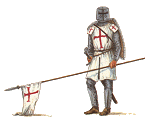
How to make a medieval costume
Introduction The clothing in the Arthurian Society is based loosely on the clothing of the Arthurian legends. This means that the costumes used within the society are based on clothing from between the 5 th and 15 th centuries. The costumes worn in the Arthurian Society do not claim to be accurate reproductions of such clothing but is are based on them, influenced by films, books, etc..Most of the costumes used in the society are mostly based on Anglo-Saxon and early medieval clothing as later in the middle ages clothing became more complex and fitted and therefore more difficult to make.
Inspiration There are a variety of sources for costume ideas; the costumes worn by other members of the society, films, television and art. The Pre-Raphaelite paintings of the Arthurian legends are a good source of costume ideas. Also have a look at the dress-up knight and lady on the center pages, and any other pics you like in the magazine. Above all use your imagination.
Colours and Fabrics Contrary to popular beliefs very colourful dyes were used in medieval clothing. However they were very expensive, of course this is not a problem to us noble lords and ladies of arthurs court. Some colours such as flame pink are probably best avoided though they may have actually existed in the middle ages (for taste reasons if nothing else). A more medieval feel is given to costumes using single coloured and , striped fabrics and those with a pattern woven into the fabric rather than fabrics with dyed patterns. Fabrics available in the middle ages included linen, wool, felt, velvet and silk, and various damasks and brocades. Although these can be used they present certain problems. These are generally not suitable in the arthiurian society due to expense and the dificulty of cleaning thease fabrics. Cotton, poly-cotton, linen look and velveteen materials are useful alternatives. Cotton gabardine and drill are good but more expensive than ordinary cotton. Synthetic fabrics that have a pronounced sheen should gfenerally be used sparingly if at all. (Unless you're Becca - 'I adore satin') It is advisable to wash offcuts of material before the finished costume to avoid disasters.
Accessories Both men and women should wear jewellery as appropriate, especially large brooches to secure cloaks. Past time’s is a popular source of jewellery but there are many other shops with suitable jewelry about (which are often cheaper). Celtic style jewellery is particularly popular amongst the lords and ladies of the court. As it was considered a little riscay, for women not to wear headdress. These can be made with a ring of flowers, or by wearing a scarf in your hair.
Handy Hints A simple costume can often be made striking by the details; the braid used, a coat of arms, the belt, jewellery, pouches, etc. It is generally advisable to keep things simple and concentrate on the details. Most medieval outfits involved two or more layers, either an overtunic and undertunic, a surcoat and gown, etc. Rather than having to make both layers, at least at first it is possible to cheat. A sleeved T-shirt can be used as an undertunic. A tight bodysuit can be can be used as the sleeves of an undergown or long length tunic. Hose can be imitated by buying or borrowing a pair of leggings, I have also heard men’s dancing tights recommended. Black (but definitely NOT blue) jeans can be used instead of breeches. Shoes or boots are a problem, having medieval looking ones made is very expensive and making them yourself would require a good standard of leather working. Most people use DM’s, walking boots, sandals or shoes. King Pellinore made a tabard out of an authentic Indian dress from the Emporiumby removing the gussets Braid can make a plain costume more exciting, furnishing braid is usually cheaper and is often more suitable for medieval costumes. Females will often find dresses in chain stores around Christmas, that will suffice. Women can make convincing costums from a body and length of material. The material can be made into a simple elasticated skirt, while sowing drapy sleeves on at the shoulders. Necks A variety of shapes of neck can be used (depending on the garment). The oval neck is fairly easy to make and is most suitable for surcoats and tabards. Rectangular necks were used for tunics and are the easiest to make but they were not popular during most of the middle agesAnother type of neck commoin on tunics, is a circle with a slit at the front to allow the head to fit through.. Oval and rectangular necks have to be fairly large, round necks with a slit can be much smaller. A total circumference of about 25 cm should fit most people.
Coats of Arms You may wish to produce a costume with a coat of arms on it. How difficult this is varies considerably from Galahad’s red cross to the Orkney clans double headed eagle. If you do not know your character’s coat of arms you can always make one up, heraldry is quite simple and you can probably find someone to help you and lots of books at all levels. As a note, while men’s coats of arms were drawn within a shield, women’s were often drawn within a lozenge. There are a number of ways to go about actually making a coat of arms. In the middle ages it would probably be embroidered or appliquéd onto a garment: however this is time consuming and few people are skilled enough to do them well. Alternatives include using fabric paints or felt. Felt can be sewn or glued (be careful and try it out on scraps as many glues will show through) like appliqué but without needing to be protected from fraying. Normal felt is not washable but there is a type of washable felt available, under the trade name of Funtex.
What you Need Many of you may be new to sewing and making costumes. A sewing machine is definitely not necessary, as I make most of my costume’s with just a needle and thread. Having said that a sewing machine is considerably faster than hand sewin. No matter how you are actually going to make the costume you will need; an air soluble pen or chalk to mark out the material, pins to hold everything together while you are sewing, and a tape measure.
Simple Patterns The easiest men’s costume to make is a tabard. In its simplest form this is just a rectangle of fabric folded in half with a hole for the neck. This is then belted around the waist. A slightly more complex tabard is shown right, this is a rectangle of cloth, but also has semicircular sleeves. The front and beck of the tabard can also be sewn together at the sides , leaving long slits for the arms.
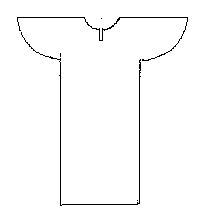

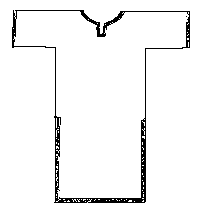
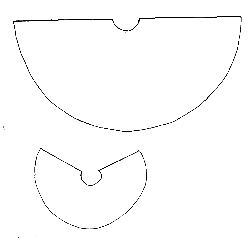
The tunic is another simple medieval costume. It changed little over the medieval age. Two designs of tunic are shown. The first with straight sides, split below the waist and the second with a full skirt. The greater the angle between the sides of a skirted tunic , the more full the skirt will be. A tunic can be as long as you wish, during the middle ages the length of garments was a status symbol as it showed that the wearer could afford more expensive fabric. The easiest way to make a short sleeved tunic is to fold a rectangle of fabric in half and mark the pattern on one side, then sew the sides together and hem the sleeves, neck and the bottom of the skirt. Long sleeves can be made using wider fabric or adding two rectangles of fabric where the arm will be to create the extra width. There are two basic forms of cloak suitable for the Arthurian society. The rectangular cloak is just a rectangle of fabric wrapped around the shoulders and fastened with a sturdy brooch. The semicircular cloak is a semicircle of fabric with a smaller semicircle of fabric cut out for the neck, this is fastened with a cord and/or two brooches. Both these cloaks are suitable for men or women. Semicircular cloaks can be extended to more than half a circle as shown below, however this usually requires more than one piece of fabric.
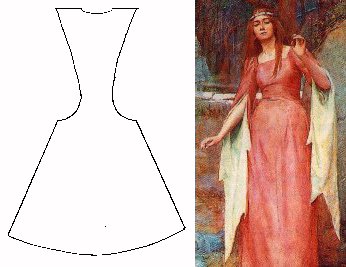
A simple female peasant/Anglo-Saxon costume can be made by wearing a knee to calf length skirted tunic with elbow length sleeves over a ankle length sleeved undertunic (or alternatively a body suit with a long skirt). A popular 13th - 14th century ladies costume was the sideless surcote. This simple pattern is shown to the rightand can be worn over a bodysuit. Alternatively a modern A pattern can be modified by giving it bell sleeves as shown in the picture on the far right.
--------------------------------------------------------------------------------
There are a variety of sources for costume ideas; the costumes worn by other members of the society, films, television and art. The Pre-Raphaelitepaintings of the Arthurian legends are a good source of costume ideas.Above all use your imagination. This section is just things I have beentold or learned through making my own costumes. If you think you have agood idea that isn't covered here, try it out. I apologise in advance forthe concentration on men's costume but that is what I know most about.There are several types of costume that can be used for both men and womenjust by altering the length and minor alterations. Please note that diagrams mentioned in the text may well not yetbe present due to workload and scanning hassels Fabrics Fabrics available in the middle ages included linen, wool, felt, velvetand silk, and various damasks and brocades. Although these can be usedthey present certain problems. The problems with using such materials in costume centre on expense,and the fact that many of these fabrics require dry cleaning. Alternativessuch as Cotton, Cotton gabardine and drill, poly-cotton, linen look andvelveteen materials are useful alternatives. Fabrics such as syntheticsatins that have a pronounced sheen are not authentic (silks used in themiddle ages resemble fine linen more than what most people think of assilk today, appearing more like the silk used in silk suits today) butif that's the look you want there is nothing stopping you using it. A general rule of thumb to getting fabrics which appear authentic isto stick to those whose weave you can see . It is advisable to wash offcuts of material before the finished costume as disasters can occur evenif you follow the instructions It will also show if the fabric is likelyto fade significantly in the wash. It is also advisable to wash many fabricsbefore you use them as they may shrink significantly when they are firstwashed. Contrary to popular beliefs very colourful dyes were used in medievalclothing. However they were very expensive and prone to fade. Very brightcolours are probably best avoided though some may have actually existedin the middle ages (for taste reasons if nothing else) to produce a moremedieval feel . A more medieval feel is given to costumes using plain colours,striped fabrics and those with a pattern woven into the fabric rather thanfabrics with dyed patterns( no floral prints). NOTE: In Cardiff The best places to look for fabric are thefabric shops on City Road, particularly Fabrico. What will available variesgreatly, so if there is something you want don't wait too long to get it,and also don't dismiss a shop because there wasn't anything you wantedlast time you looked. Coats of Arms You may wish to produce a costume with a coat of arms on it. How difficultthis is varies considerably from Galahad's red cross to the Orkney clansdouble headed eagle. If you do not know your character's coat of arms you can always makeone up, heraldry is quite simple and you can probably find someone to helpyou and lots of books at all levels. As a note, while men's coats of armswere drawn within a shield, women's were often drawn within a lozenge. There are a number of ways to go about actually making a coat of arms.In the middle ages it would probably be embroidered or appliquédonto a garment: however this is time consuming and very few people knowenough to do them well. Alternatives include using fabric paints or felt.Felt can be sewn or glued (be careful and try it out on scraps as manyglues will show through) like appliqué but without needing to beprotected from fraying. Normal felt is not washable but there is a typeof washable felt available, under the trade name of Funtex. Jewellery Both men and women should wear jewellery as appropriate, especiallylarge brooches to secure cloaks. Past time's is a popular source of jewellerybut there are many other shops with suitable jewellery about (which areoften cheaper). Celtic style jewellery is particularly popular amongstthe lords and ladies of the court. Handy Hints - It is generally advisable to keep things simple and concentrate onthe details. - A simple costume can often be made striking by the details; the braidused, a coat of arms, the belt, jewellery, pouches, etc. - Most medieval outfits involved two or more layers, either an overtunicand undertunic, a surcoat and gown, etc. Rather than having to make bothlayers, at least at first it is possible to cheat. A sleeved T-shirt canbe used as an undertunic. A tight bodysuit can be can be used as the sleevesof an undergown or long length tunic. - Hose can be imitated by buying or borrowing a pair of leggings, Ihave also heard men's dancing tights recommended. Black (but definitelyNOT blue) jeans can be used instead of breeches. - Shoes or boots are a problem, having medieval looking ones made isvery expensive and making them yourself would require a good standard ofleather working. Most people use DM's, walking boots, sandals or shoes. - King Pellinore made a tabard out of an authentic Indian dress fromthe Emporium. To do this he removed the gussets. - Braid can make a plain costume more exciting, furnishing braid isusually cheaper and is often more suitable for medieval costumes. Tools Many of you may be new to sewing and making costumes. A sewing machineis useful but is definitely not necessary, as I make most of my costume'swith just a needle and thread. Hand sewing does produce a more authenticresult though modern hand sewing often utilises different stitches thanwould be used in the middle ages. You can also get iron on products, suchas bondaweb, to fix material together. In my opinion while these are suitablefor hems they are not usually reliable for seams. No matter how you are actually going to make the costume you will need; An air soluble pen or tailors chalk to mark out the material pins tohold everything together while you are sewing A tape measure to measure yourself A ruler (the longer the better) to mark out the fabric A pair of scissors to cut the material Crimping shears are very expensive (about £20 ) however if youcan get access to some they are useful and the zig zag edge they make ismuch less affected by fraying. Measurements It is all too easy to make a costume that is too tight. The followingrules of thumb are what I use for tunics surcoats and the like. I makethe body of my costume about 10 to 15 cm centimetres wider than my chestmeasurement depending how loose I want it. Most costumes are put on overthe head and so can't be tapered to the waist as it will be impossibleto put on. Another problem can be sleeves that are too narrow, most ofmine are about 30cm wide at the body with a wrist size of 20-25cm. Thesketch below shows the measurements required for a tunic and this can beadapted for the other costumes. Hems In the middle ages single hems (see below) were by far the most commonand some garments (especially fine clothes which would not be worn or washedoften) would have no hem at all. However today double hems preferable asthey produce a more professional result in unlined clothing and are moredurable Necks A variety of shapes of neck can be used (depending on the garment).The oval neck is fairly easy to make and is most suitable for surcoatsand tabards. Rectangular necks were used for tunics and are the easiestto make but they were not popular during most of the middle ages. The most authentic neck, for tunics in particular, is a circle witha slit at the front to allow the head to fit through. This is done as illustratedin the pictures below; a rectangle of material is sewn to the inside ofthe neck where the slit is to be with the outside facing the inside ofthe costume, the slit is then cut through both layers of material and therectangle of cloth brought through the slit, the edges folded under andsewn in place. A modern alternative to this is to use bias binding .Ovaland rectangular necks have to be fairly large, round necks with a slitcan be much smaller (a total circumference of about 60 cm should fit everyone). Medieval Patterns Early medieval patterns are based mostly on rectangles and triangles,these are than used to make up more the complex shapes in garments (seethe diagram). This system was used to avoid wasting expensive materialand because due to hand the width of fabric was much less than that commontoday (about forty five centimetres as opposed to more than a meter). Usingthis system of producing costume will produce garments that look more likethe real thing and is good for students as it still reduces the wastageof fabric, it does however involve much more sewing (some of which is difficultor impossible by machine) and is more complex. This system was phased outin the later middle ages as more complex and fitted garments were introduced. Patterns There follows a set of diagrams and instructions for a wide varietyof Medieval (mostly early medieval) costumes. this section will increaseover time as I get around to adding to it. Cloaks The simplest cloak is a rectangle of cloth. This is wrapped around theshoulders and fastened by a brooch. There are several ways in which towear a rectangular cloak the best way to learn to put on such a cloak isto ask someone to show you. One of the main problems with this type ofcloak is their tendency to slip and the difficulty in finding broocheswith a strong enough pin. The next type of medieval cloak is the semicircular cloak shown below.This is wrapped around the shoulders with the neck at the centre and fastenedwith a cord, chain and or a pair of brooches. The example to the rightshows a cloak which is extended to more than a semicircle. Cloaks couldbe extended in this way to a full circle. A problem with this type of cloakis that the weight of the cloak can pull the cord back across the neckthat can be uncomfortable. Fitted cloaks were not in use historically tillthe sixteenth century but they are warm, comfortable and many have hoods.Patterns for such cloaks can be bought commercially but a sketch of oneis shown below. An important note is that if you line a cloak, do not sewthe bottom edge of the lining to the cloak as it will not hang correctly. Barbettes, Couvrechefs, Veils and Wimples An English barbette can be made from a strip of white fabric which canbe wrapped around the head from under the chin and be pinned in place.A French barbette is effectively a wimple. A couvrechef is equally simple.It is just a long fairly narrow rectangle of cloth (usually white). A wimplecan be made from a rectangle of cloth that is pinned to the hair so thatit falls down covering the neck. An alternative to pinning a wimple tothe hair is to wear a filchet, a narrow fabric headband and pin or otherwiseattach the wimple to that. There are several different types of veils.Two of the more common ones are shown below. Coifs The pattern for a simple coif is shown below. The slits are sewn togetherso each A is next to the other. Then a pair of cords are attached to thetwo corners marked B. Hats and Hoods There are a variety of designs of hoods all of which are fairly easyto make. Hats are even more diverse and range from the basic to the extremelycomplex. Below are a number of simple patterns for hats and hoods . A Ladies Cotehardie or Gown Cotehardies are a more fitted garment than a tunic, tabard or surcote.They require a pattern to construct. A women's cotehardie can be producedby modifying a commercial pattern for a princess line dress depending onthe style of cotehardie you want. A simpler women's gown is also show below,this is from an article written by Sally while she was the regent Tabards A simple tabard is the simplest costume. It is a rectangle of clothwith the edges hemmed and a hole cut for the neck. More complex is a tabardin which the sides are sewn together. This is made in the same way as atunic with 'flaps' except that it has no sleeves. Tabards can also havesmall 'sleeves' as shown below. Surcoats A footman's sleeveless surcoat can be made in the same way as a tabardexcept usually longer, from just below the knee to ankle length, and thesides are sewn shut. A sleeved surcoat can be made in the same way as atunic with 'flaps' but again much longer. A horseman's surcoat is splitat the front and rear rather than the sides to aid in riding. This is achievedby making the surcoat out of four pieces of material, with a seam up thefront and back, or the slit can be edged in the same way as a neck slit.a surcoat made out of four pieces of fabric can easily be made parti-coloured A sideless surcoat or cyclas can be made in the same way as a long skirtedtunic but instead of having sleeves the arm holes are cut back so thatthe sides are not sewn together till the waist, alternatively the frontan back can be separate and laced together at the waist. A men's cyclasalso the cyclas should have a centre slit as described above. Women's sidelesssurcoats are often exaggerated with armholes so wide that only a narrowband of fabric remains front and back. Tunics There are two basic types of tunic, those with a full skirt and thosewith 'tabs' (split down the side). There are however many varieties of tunic which were in fashion at differentperiods, these mostly vary in the fullness of the skirt and the style ofthe sleeve; a variety of different styles of tunic are shown below. Bothmen and women can wear tunics, differing only in length; women's tunics(and other clothes) would be ankle to floor length or longer, while men'sclothes would range in length from just above the knee to ankle length.Another trend in the length of tunics was for nobles and the wealthy towear longer garments to show of their wealth in the amount of expensivefabric they could afford. Although a tunics were made of multiple pieces of material the easiestway to make a loose short sleeved tunic involves a single piece of material.This is folded in half (with the side that will be the outside on the inside)and the shape of the tunic marked on one side. The fabric is pinned alongthe seam and sewn together. Then the waste material is cut off and thehem along the sleeves and skirt is folded back on itself and stitched inplace. Then the neck is cut out and hemmed. This produces a loose skirtedtunic when turned right side out. Alternatively instead of a skirt, a tunic with 'flaps' and slits atthe side can be produced. This is marked out with a straight line verticalfrom the armpit down to the hem. This is then sewn down to the waist. Belowthe waist the fabric is simply folded back and fixed in place producingthe slit. These are the two main types of tunic. The procedure above canbe used to produce a long sleeved tunic if wide enough fabric can be found,or two pieces of fabric can be sewn together lengthways (with the sidesthat will be outside facing each other)and this seam treated as the foldin a single piece of material. However this wastes lots of material solong sleeved tunics are best made in more than one piece. Pouches Pouches are very useful for carrying things in costume and are easyto make. There is a range of designs using leather or tough fabric. Thefirst is based on a tube. To make this pouch cut out a circle and a rectangleof material and sew them into a tube. Next fix a loop of fabric to theside of the tube to make a belt loop. Next fit an even number grommetsequally spaced around the tube two thirds of the way up . Finally threada cord in and out of the grommets or between the strip of material andthe pouch and pull it tight. A variation of this idea is to place the loopat the top of the tube and thread the cord through the top hem after cuttinga slot in it to provide the drawstring . A second type of pouch can be made by folding a piece of material intwo and sewing sides together to make a pocket. . Then hem the top edgeand putting on a loop and drawstring in the ways described above to finishthe pouch . A third type of pouch works best with thick fabric or thin leather,this is simply a circle with an even number of holes around the circumferencethrough which a draw string is threaded to produce a pouch. a belt loopcan then be threaded through a couple of the holes.
--------------------------------------------------------------------------------
A Beginners Guide to Medieval Costume
This Article is split into two sections. The first section deals with descriptions of the items and types ofdecoration worn during and around the medival period While the second section provides instruction on how to construct yourown costume. If you know everything you want about what was worn in medieval timesyou can jump straight to costume making here. Baldric (Baldrick) A leather belt or silk sash, usually richly ornamented. It was wornaround the body over one shoulder to the opposite hip to carry a sword,dagger, pouch, etc. Baldric's were worn from the 1340's. In the tale orGawain and the Green knight it says all knights of the round table worea green baldric to commemorate that adventure. Barbette In France a barbette is usually a veil fixed above the ears to the hairor head-dress that then fell in folds to cover the neck as a wimple. InEngland a barbette was a strip of white linen worn under the chin and drawnup at each side to be fastened on the top of the head. Bliaud A Bliaudis a long belted overtunic worn by both sexes between the eleventh andearly fourteenth century. Women wore a ground length bliaud decorated atthe hem and neck. Women's Bliauds were fitted over the torso and had widefull length sleeves. Noblemen wore a calf or ankle length Bliaud similarlydecorated with the skirt split at the sides to aid in riding. Lower classmen wore a knee length Bliaud. Boots Boots were an important article of clothing in the middle ages especiallybefore the mid fourteenth century. They were useful in travelling and inhouses which lacked modern comforts. Many styles of boot were mid calflength with turned down or rolled tops, and were usually laced up the side.A taller knee length boot was called a Buskin or brodequine. Fashionablecourt boots were brightly coloured and made of soft leather, and embroideredor brocaded silk. Travelling boots were usually made of leather. In thedark ages felt boots were also common in some areas. In the fourteenthcentury the toes of all footwear became extended to great lengths. Tallleather boots with heavy soles but open toes were known as Heauze or Houseaux.These varied in height from mid-calf to mid-thigh and were similar to romanand Greek designs. Hauze were used from the ninth until the fourteenthcentury. Breech's In the Dark age's breeches or brais were loose knee length trousersworn by men. They were not worn in the middle ages but ornate breechesbecame popular in the sixteenth century. Cap's In the thirteenth century the phrigian cap was popular. This was a roundfelt hat that came to a point in the front or had a forward pointing 'stalk'in the centre. It was originally Anatolian but it was seen across Europefrom early times into the middle ages. The skullcap was popular from thetwelfth century until the fifteenth. It is a small round hat closely fittingthe top of the head with no brim or peak though sometimes a tail was present.A version of the skullcap, the biretta had by the fifteenth century developedinto a stiffened square shape. The biretta was worn by academics The conicalhat popular in ancient times remained in use into the middle ages. Womenoften wore jewelled and embroidered caps of rich fabrics to contain anddecorate their plaited or coiled hair. They were particularly popular inthe late middle ages. Cloak's The cloak has been made from every possible shape and size of material.In ancient times it could be circular, semicircular, rectangular or a square.It was not sewn but draped or pinned about the wearer. In Medieval time'scloaks were similar but fastened by cords or brooches at the neck. It wasnot till the sixteenth century that shaped sewn and lined cloaks were introduced.In the dark age's cloaks were knee or ankle length and some had hoods attached.In the early middle age's cloaks were often very long and voluminous. Insteadof a brooch fastening a cord or chain was sometimes used, these were fixedto metal bosses on each side of the opening. Later in the middle age'scloaks were worn less often, only when they were needed for warmth. Thiswas due to the full outer garments that became common and the developmentof separate hoods. Coif A coif was a white linen cap worn by both sexes (also the name of mailhead armour, usually worn under a helmet). It was close fitting and tiedaround the chin. It was worn from the early middle ages onwards as a night-capor under another hat. A padded coif was also worn under a mail coif byknights and soldiers. Cotehardie's The cotehardie was an outer tunic or gown worn by both sexes in thefourteenth and early fifteenth centuries. The exact form of a cotehardieis not clearly defined. In the early fourteenth century the male versionwas a three quarter length tunic with wide sleeves a round neck and buttoneddown the front. From about 1340 it was shorter and more fitted, with elbowlength sleeves. The female cotehardie was a full length gown with a wideneckline and fitted torso with a full long skirt. Couvrechefs A couvrechef was a veil that was draped around the head then hung looseor tucked into the neckband of a gown. The Anglo-Saxon term for a couvrechefwas headrail. Couvrechefs were discarded by the upper classes in the fourteenthand fifteenth centuries but remained everyday wear for the lower classes. Doublet's (Gipon's, Pourpoint's, Gambeson') Doublet's were worn by men between the fourteenth and seventeenth century.In the fourteenth and Fifteenth centuries they were known as gipon's (jupon's)and pourpoint. They were derived from the gambeson that was a thick paddedgarment worn as body armour or under a mail shirt or hauberk. The giponwas a high necked hip or waist length tunic of the fourteenth centuries.The pourpoint of the late fourteenth and early fifteenth centuries wassquare necked with a knee length skirt. Gard-corps The gard-corps was a thirteenth century garment. It was loose and unbelted.It was worn over an under tunic. It was ankle or three-quarter length andhad wide sleeves that were gathered at the waist and slit to allow thearm to pass through while the rest of the sleeves hung in folds behind. Girdle A girdle was a belt for the waist or hips. Girdles were made of metal,leather, fabric or cord and often had one or two hanging ends. Often objectswere attached to or hung from a girdle: purse keys, knife, etc. Gloves Gloves were a symbol of power in the middle ages. This was especiallytrue with royalty and high ecclesiastical offices whose gloves were madeof deer or sheepskin. Gloves played a part in the investiture of knightsand bishops. Gloves were given to holders of civic offices on certain occasions.Strong leather gloves were used for hawking and falconry, important pastimesof the nobility. In the middle ages most people would use mittens ratherthan gloves. Gown's The gown has been worn by women from Saxon times. Styles have variedbut it has always been of at least ankle length. The cote, surcoat, houppelandeand cotehardie are all types of gown. In the early middle ages the gownwas long, full and loose fitting. It usually had a round neck split inthe front to allow it to be put on over the head. Most gowns were decoratedwith embroidered borders at the wrist and neck. In Saxon and Norman timesthe outer gown could be three-quarter length showing a floor length undergown.In the second half of the thirteenth century gowns were word ungirded andan overgown known as a cyclas or surcoat was introduced (see surcoat).In the fourteenth century gowns became more tailored and of much closerfit. Parti-colouring and counterchange designs were introduced as weretippets. As well as the sideless surcoat Houpplande's were very populartill the mid fifteenth century. From the fourteenth century till the midsixteenth gowns were also worn by men though they were very different tothose worn by women. Such a gown was worn by noblemen on top of a tunicand hose. It was long full and loose, open at the front with wide amplesleeves. It was made of velvet or damask and often lined with fur. Latergowns got shorter only reaching the knees or hips. Hanging sleeves werepopular or the cuffs were pushed up the arms so the material was drapedin many folds. Hat's Hat's were worn by men in Europe from classical times but until thesixteenth century it was rare for women to wear hats. During the middleages hats were worn only by men of rank and importance, the more commonhead covering was the hood. In the fifteenth century it became fashionableto wear a hat. There were a wide variety of hats from the sugar loaf hatto the hunting design with turned up rim and a long point, now firmly identifiedwith robin hood. Head-dresses Head-dresses were very popular in the fifteenth century they were madeup of metal, jewelled cauls velvets and silks, they were covered by veils.The most common styles included the infamous steeple head-dress, this isa long cone of brocade, velvet, cloth of gold or silver stiffened intoa cone. Then the cone is attached to a black velvet cap visible as a bandaround the base of the head-dress. It was commonly worn on the back ofthe head at an angle of about forty degrees. A truncated version, as wellas two and three coned versions were also known. Veils were often wiredto achieve an attractive shape. A popular shape was the butterfly in whicha double veil was shaped into two ridges further apart at the back. Hoods Hoods were worn from ancient times. They were worn separately as wellas attached to cloaks. They were used throughout the middle ages. Theywere originally simply a head covering buttoned or laced at the front.Later they were extended to include a shoulder cape. From the Fourteenthcentury the point on the top lengthened into a padded sausage that hungdown the wearers back, this extension was known as a liripipe. Later stillnew complex ways were developed to wear a hood. The common method was toput the face opening over the head and arrange the cape to hang in folds,either in front behind or to the side. The liripirpe Then hung loose onthe other side. By the 1420's more formal arrangements had been made forthe arrangement of hoods had evolved. The hood was modified so it was nolonger necessary to re-drape it each time it was put on. Women also worehoods, which were usually attached to capes for travelling. Hose From the fourteenth century as cloths were tailored to fit this trendwas applied to the chausses, from this point they are usually refered toas hose. They were in the form of two long stockings. They were kept upby being lace through eyelet holes at the bottom of the under tunic. Laterthe legs of the hose were joined and worn with a codpiece. Women wore similarhose but theirs only extended up to just above the knee. In the fourteenthcentury soled hose were often worn instead of shoes. It became the fashionto wear hoes with extended toes. This became so extreme that it becamedifficult to walk and toes had to be tied to the calf and stiffened withwhalebone. It was actually made illegal in England to wear hose extendingmore than three and a half inches beyond the toe. In the fifteenth centuryparti-coloured and stripped hose became popular. Houppelande's The houppeland was a voluminous outer garment derived from Flemish styles.It was by both sexes worn between 1360 and the late fifteenth century.The houppeland could be any length between mid calf and sweeping the ground(the female version was floor length). The houppeland was fitted on theshoulders and very full, draped in many folds, and usually belted. Theneckline followed current tunic styles except for the fourteenth centurywhen it had a very high neckline often up to the ears!. It could be buttonedall the way up the centre front but more often it was not open but wassplit to knee level at the sides. The sleeves were always wide and oftendagged. Houppelands were often lined in contrasting colours and furs. Pattens Pattens were overshoes made of leather metal and wood. They were fastenedto the foot by cloth or leather straps. They were worn to raise shoes andsoled hose above the mud and reduce ware on the sole. In the middle agespattens were just a lump of wood under the ball of the foot and anotherunder the heel with an arch in between. Shoes The early form of the shoe was a single piece of rawhide (often withthe fur still attached). These were attached with a thong of leather orsinew. They were still common in the dark ages and were used in remoteareas by the lower classes till the beginning of the twentieth century.Also common in the dark ages were simple sandals similar to those usedby the Romans and Byzantine's By the eleventh century shoes were maybefrom a separate sole and upper stitched together. In addition to leathercourt shoes were made of silk damask, and embroidered velvet. The pointed-toe shoe was introduced in the late eleventh century and in the fourteenthand fifteenth centuries reached excessive lengths. These piked shoes wereknown as poulaines. The shoes used in the middle ages were ankle shoesfastened with a buckle or button though rolled top versions laced up theside were also known. Surcoat's The surcoat or surcote was a garment worn over a tunic or cote. Thesurcoat was worn in civilian as well as military use and came in many variedforms. The male version was three quarter length showing the tunic beneath.In the late twelfth century the male Surcote developed sleeve. These wereoften long and loose and would have slits in the front at elbow level forthe arms to pass through turning the sleeves into hanging sleeves. In thefourteenth century the surcoat became less loose and sleeves were morecommonly three quarter length. Women also wore surcoats in the thirteenthcentury. At the time they were known as a cyclas. They were sleevelessat first with wide armholes (such cyclas made of rich materials were alsoworn by knights on ceremonial; occasions). Later hanging and three quarterbecame popular. In the fourteenth century Sideless surcoats became popularwomen's wear. These were worn over a underdress. They had a wide necklineand had huge armholes \reaching to the hip. Tabard's The tabard was originally a practical garment used by crusading knightsto protect them from the sun on their metal armour. It would often be decoratedwith a heraldic device to aid in identification. In the twelfth centuryit was adopted into civilian use worn over a tunic. The tabard was oftenused by heralds, decorated with the arms of their lord. A tabard in itssimplest form is just a rectangle of cloth with a hole for the neck. Tippets Tippets were pendant streamers hanging from the elbow length sleeveof the tunic or gown. This term was also sometimes used for the liripipeof a hood. Tunic's Tunic's have existed in different forms since ancient times. The tunicwas the usual wear in Europe before during and after the occupation ofthe Romans. For men the tunic was normally knee length, though the nobilitywould wear it ankle length. Women would sometimes wear a knee length tunicover a ground length gown. The tunic was eventually replaced by the fitteddoublet in the fourteenth century. Trousers In dark age Britain and Europe long loose trousers were widely worn.They were sometimes tied at the bottom or at the knee but they were alsooften worn loose. They were replaced by the chausses leg coverings of theCaroligians and Merrovingioans that later developed into medieval hose.These were often cris-crossed to the knee until the eleventh century. Closefitting trousers were also worn by both sexes in Byzantium. Byzantine fashionsexerted an important influence on Carolingian clothing and influenced thedevelopment of hose. Turbans Turbans are made up by wrapping a long piece of material around thehead in a variety of ways. They were popular in Europe from the early fifteenthcentury till the beginning of the sixteenth century. Veils Veils were originally made of linen silk and even wool, however as itbecame possible to weave fine semi-trasparent materials these were adoptedfor long flowing veils. In early time's veils were simply pieces of fabricheld in place by a fillet (band of material), ribbon, or pinned to thehair. In later period's veils accompanied the head-dress. They were drapedover it, around it or flowing down the back. In fifteenth century veilswere particularly popular worn with horned, and steeple head-dresses, cauls,turbans and occasionally wired into butterfly wings. Wimples A wimple is a women's head-dress popular from the twelfth to the midfourteenth century (and less fashionable in the fifteenth century). A wimpleis a piece of, usually white, silk or linen. A wimple was fastened to thehair on the crown of the head, or on each side above the ears and drapedto cover the chin neck and throat. The lower edge of a wimple was oftentucked into the neckline. Wimples were worn with a veil or couvrechef. Back to top